 Cessio
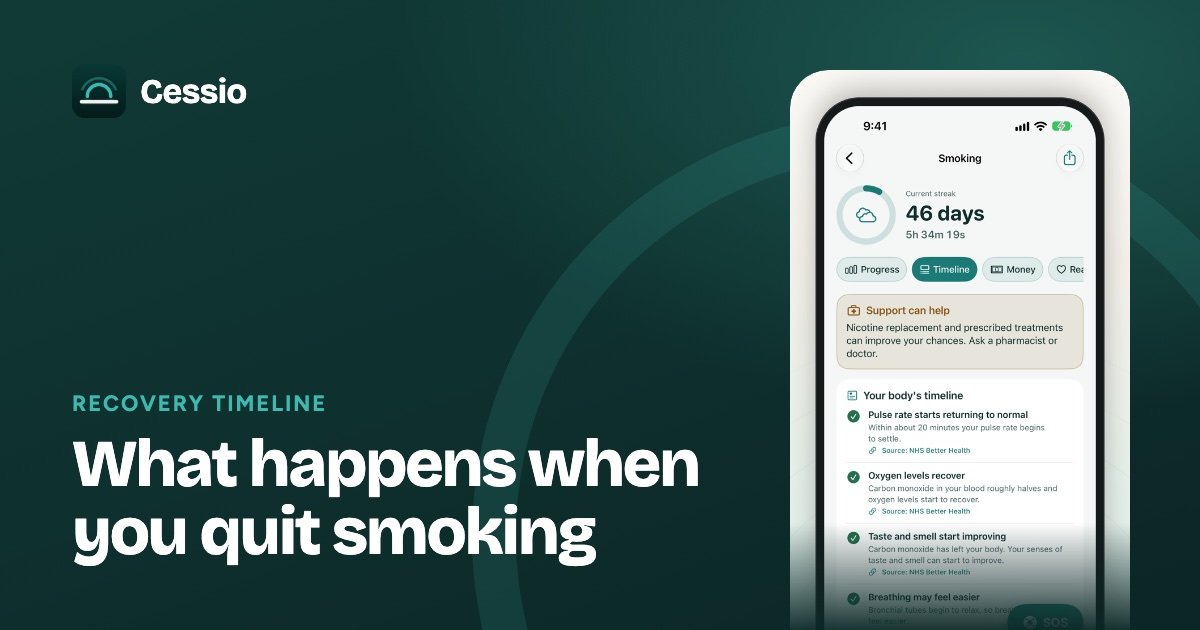
Short answer: your body starts to recover within minutes of your last cigarette. Heart rate and blood pressure drop within about 20 minutes, carbon monoxide in your blood falls to normal within roughly a day, and breathing and circulation improve over the following weeks. Over the years that follow, your risk of heart disease, stroke and several cancers keeps falling. Around 10 years after quitting, your risk of lung cancer is about half that of someone who still smokes.
Knowing what is happening inside your body makes the hard days easier to get through. Below is a milestone-by-milestone guide, built from the CDC, the World Health Organization, the American Cancer Society and the NHS. Where these sources give different timings, we say so, because recovery is not identical for everyone.
The quit smoking timeline at a glance
| Time since your last cigarette | What changes in your body | Source |
|---|---|---|
| 20 minutes | Heart rate and blood pressure drop | WHO |
| 8 hours | Carbon monoxide and nicotine levels in your blood have halved | NHS Wales |
| 12 to 24 hours | Carbon monoxide in your blood falls to a normal level | WHO, NHS Wales |
| 1 to 2 days | Nicotine leaves your blood; taste and smell start to improve | CDC, NHS Wales |
| 3 days | Breathing feels easier and energy levels rise | NHS Wales |
| 2 to 12 weeks | Circulation improves and lung function increases | WHO |
| 1 to 12 months | Coughing and shortness of breath decrease | CDC, ACS, WHO |
| 1 to 2 years | Risk of heart attack drops sharply | CDC |
| 3 to 6 years | Added risk of coronary heart disease drops by half | CDC |
| 5 to 10 years | Added risk of mouth, throat and voice box cancer drops by half; stroke risk decreases | CDC, ACS |
| 10 years | Lung cancer risk is about half that of a person who still smokes | ACS, WHO |
| 15 years | Coronary heart disease risk is close to that of someone who does not smoke | CDC, ACS |
| 20 years | Risk of mouth, throat, voice box and pancreatic cancer is close to that of someone who does not smoke | CDC |
The first 24 hours: your heart and blood start to recover
The first change is the fastest. According to the WHO, within 20 minutes of your last cigarette your heart rate and blood pressure drop. The CDC simply puts this at “minutes”.
Next comes carbon monoxide, the gas in cigarette smoke that takes the place of oxygen in your blood. NHS Wales says carbon monoxide and nicotine levels have halved after 8 hours, and that your body has got rid of the carbon monoxide by 24 hours. The WHO puts the return to normal at 12 hours, while the CDC says it can take several days. Either way, your blood starts carrying more oxygen within the first day.
Many people notice the first cravings in this window too. That is normal, and it means your body is adjusting.
Days 2 to 3: nicotine leaves and withdrawal peaks
The CDC says the nicotine level in your blood drops to zero within about a day; NHS Wales describes your body as nicotine free by 48 hours, with taste and smell starting to improve. By 72 hours, NHS Wales says breathing feels easier and energy levels rise.
This is also when withdrawal is usually strongest. The National Cancer Institute says symptoms are usually worst during the first week, peaking during the first 3 days. If days two and three feel like the hardest part, that is because they often are, and it gets easier from here.
Weeks 2 to 12: better circulation and stronger lungs
Between 2 and 12 weeks after quitting, the WHO says your circulation improves and your lung function increases. In practice, many people find that walking, climbing stairs and exercise start to feel easier during this period.
Your mood can improve too. The NHS notes it can take as little as 6 weeks to start feeling the mental health benefits of quitting.
Months 1 to 12: less coughing, more breath
Over the first year, coughing and shortness of breath decrease. The CDC and the American Cancer Society place this at 1 to 12 months, and the WHO at 1 to 9 months. If a cough lasts or worries you, see a doctor.

See each milestone as it happens. Cessio shows your recovery timeline for smoking, vaping and cannabis, with every step linked to its source. Get Cessio on the App Store
Years 1 to 20: heart, stroke and cancer risk keep falling
Heart disease
The CDC says your risk of a heart attack drops sharply within 1 to 2 years, and the added risk of coronary heart disease drops by half within 3 to 6 years. The WHO and the NHS are more optimistic, saying the risk is about half that of a smoker after 1 year. By 15 years, the CDC and ACS say your risk of coronary heart disease is close to that of someone who does not smoke.
Stroke
Stroke risk decreases within 5 to 10 years, according to the CDC and ACS. The WHO says it falls to that of a nonsmoker 5 to 15 years after quitting.
Cancer
Within 5 to 10 years, the added risk of cancers of the mouth, throat and voice box drops by half (CDC). At 10 years, your risk of lung cancer is about half that of a person who still smokes (ACS), and your risk of bladder, esophagus and kidney cancer decreases (CDC). After 20 years, the CDC says the risk of cancers of the mouth, throat, voice box and pancreas is close to that of someone who does not smoke.
How long does nicotine withdrawal last?
Withdrawal usually starts within a few hours, is strongest in the first week (especially the first 3 days) and lasts 3 to 4 weeks on average, according to the NHS. Some people have milder symptoms for several months.
Common symptoms include:
- Cravings for a cigarette
- Irritability, anxiety or low mood
- Trouble concentrating
- Restlessness and trouble sleeping
- Increased appetite
The National Cancer Institute notes that symptoms ease over the first month, but occasional cravings can return months or even years later, often when you meet an old trigger. Our guide to how to stop nicotine cravings covers practical ways to ride them out.
Will I gain weight after quitting?
Some weight gain is common, but it is usually modest. The National Cancer Institute says it is usually less than 10 pounds. A 2012 BMJ meta-analysis of 62 studies found an average gain of 4 to 5 kg (about 9 to 11 lb) after 12 months, mostly in the first 3 months, while about 16% of people who quit actually lost weight. Regular meals, water and movement help, and the health benefits of quitting far outweigh a few pounds.
Is it ever too late to quit smoking?
No. The CDC says quitting can add as much as 10 years to your life expectancy, and the American Cancer Society says that quitting before the age of 40 reduces the risk of dying from smoking-related disease by about 90%. Quitting later still pays off. The WHO estimates these gains in life expectancy:
| Age when you quit | Years of life gained (approx.) |
|---|---|
| About 30 | Almost 10 |
| About 40 | 9 |
| About 50 | 6 |
| About 60 | 3 |
If it takes more than one try, you are in good company. In 2022, CDC data showed that 67.7% of adults who smoke wanted to quit and 53.3% had tried in the past year. The CDC notes that quitting often takes multiple tries, and every attempt teaches you something about your triggers.
How to give your body the best chance
- Combine medicine and support. The CDC says counseling and medication together give people the best chance of quitting for good.
- Ask about stop smoking medicines. A 2023 Cochrane review found varenicline and combination nicotine replacement (a patch plus a fast-acting form such as gum) are among the most effective options. A pharmacist or doctor can help you choose.
- Call a quitline. In the US, 1-800-QUIT-NOW offers free coaching. In England, the NHS Smokefree National Helpline is 0300 123 1044.
- Plan for cravings. Most last only a few minutes. Have a plan ready for each one.
- Track your progress. Seeing your clean days, money saved and recovery milestones add up is a strong reason to keep going.
Cessio was built for that last point. It counts every smoke-free day, shows how much money and how many cigarettes you have saved, and lets you tap SOS for guided breathing and a 10-minute urge timer when a craving hits. A slip restarts your current streak but never erases your longest streak or your total clean days.
Quick answers
What happens after 3 days of not smoking?
By day 3, nicotine has left your blood, taste and smell are starting to improve and breathing often feels easier (NHS Wales). Withdrawal symptoms usually peak around now, then start to ease (NCI).
How long does it take for your lungs to improve after quitting?
Lung function starts to increase within 2 to 12 weeks (WHO), and coughing and shortness of breath decrease over 1 to 12 months (CDC, ACS).
When does the risk of heart attack go down?
It drops sharply within 1 to 2 years of quitting (CDC). By 15 years, the risk of coronary heart disease is close to that of someone who does not smoke.
Is the first week the hardest?
For most people, yes. Withdrawal is usually worst in the first week and peaks in the first 3 days (NCI). It eases over the following weeks.
Sources
- CDC: Benefits of Quitting Smoking (updated May 2024). www.cdc.gov
- American Cancer Society: Health Benefits of Quitting Smoking Over Time (revised May 2025). www.cancer.org
- World Health Organization: Tobacco, health benefits of smoking cessation. www.who.int
- NHS Better Health: Benefits of quitting smoking. www.nhs.uk
- NHS 111 Wales: Smoke Free Timeline. 111.wales.nhs.uk
- National Cancer Institute: Handling Nicotine Withdrawal and Triggers. www.cancer.gov
- NHS Better Health: Managing nicotine withdrawal symptoms. www.nhs.uk
- CDC: Smoking Cessation Fast Facts. www.cdc.gov
- CDC: How to Quit Smoking. www.cdc.gov
- Aubin et al., Weight gain in smokers after quitting cigarettes: meta-analysis, BMJ 2012. research.birmingham.ac.uk
- Cochrane: How effective are medications and e-cigarettes for quitting smoking? (2023). www.cochrane.org
This article is for general information and is not medical advice. Talk to a doctor, pharmacist or local stop smoking service about the right support for you. Cessio is a self-help tool, not medical treatment.